
Acrylic-Based Gel & Macroporous Strong and Weak Base Anion Exchange Resins
Hydrophilic acrylic matrix anion resins (211, D211, 311, D311, D318-Ⅲ) offering reversible adsorption and complete elution of high-molecular-weight natural organic matter (NOM), ideal for ultrapure water organic scavenging, citric acid/Vitamin C purification, and vanadium/molybdenum hydrometallurgy.
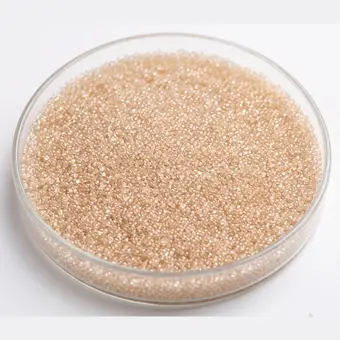
Polymer Architecture & Functional Chemistry Profile
Anion Exchange Resin · 9 Standardized & Specialty GradesCustom Screening & Ionic Conversion: Aliphatic acrylic backbone prevents irreversible aromatic π-π bonding with humic/fulvic acids and food pigments.
Grade-by-Grade Technical Parameter Table
Click any grade code or TDS button to open its individual printable Technical Data Sheet, or click + RFQ to add multiple grades to your inquiry basket.
⇄ Swipe horizontally to inspect all technical parameters
Acrylic-Based Gel & Macroporous Strong and Weak Base Anion Exchange Resins — Physical & Chemical Specifications
Acrylic–NR₂ / N⁺R₃ · Acrylic · Gel & Macroporous · 9 Grades| Grade | Ionic Form | Strong (Weak) Base Capacity (mmol/g) | Volume Capacity (mmol/mL) | Water Retention (%) | Bulk Density (g/mL) | Specific Gravity (g/mL) | Particle Size Range (%) | Effective Size (mm) | Uniformity Coeff. | Whole Bead After Attrition (%) | Color | Applications & Technical Remarks | TDS / RFQ |
|---|---|---|---|---|---|---|---|---|---|---|---|---|---|
| 211 | – | ≥3.5 (≤1.0) | ≥1.2 | 54–64 | 0.68–0.75 | 1.05–1.10 | 0.315–1.25 mm ≥95 | 0.4–0.7 | ≤1.6 | (≥90) | White | Clear gel-type acrylic strong base anion resin with excellent organic fouling resistance; widely used in ultrapure water production and in the demineralization and decolorization of various liquids | |
| 211FC | – | ≥3.5 (≤1.0) | ≥1.2 | 54–64 | 0.68–0.75 | 1.05–1.10 | 0.45–1.25 mm ≥95 | ≥0.5 | ≤1.6 | (≥90) | White | Floating-bed grade clear gel-type acrylic strong base anion resin | |
| D211 | – | ≥3.5 (≤1.0) | ≥0.8 | 65–72 | 0.65–0.73 | 1.04–1.10 | 0.315–1.25 mm ≥95 | 0.4–0.7 | ≤1.6 | ≥90 | Light yellow | Macroporous acrylic strong base anion resin with excellent organic fouling resistance; usable as an organic scavenger in ultrapure water production and in deacidification and decolorization of liquids | |
| D211FC | – | ≥3.5 (≤1.0) | ≥0.8 | 65–72 | 0.65–0.73 | 1.04–1.10 | 0.45–1.25 mm ≥95 | ≥0.5 | ≤1.6 | ≥90 | Light yellow | Floating-bed grade macroporous acrylic strong base anion resin | |
| 311 | Free amine | ≤1.3 (≥4.0) | ≥1.6 | 56–63 | 0.66–0.74 | 1.04–1.10 | 0.315–1.25 mm ≥95 | 0.4–0.7 | ≤1.6 | (≥90) | White | Clear gel-type acrylic weak base anion resin with very high organic fouling resistance; mainly used for treating water with a high organic load and for deacidification and decolorization of process streams | |
| 311FC | Free amine | ≤1.3 (≥4.0) | ≥1.6 | 56–63 | 0.66–0.74 | 1.04–1.10 | 0.45–1.25 mm ≥95 | ≥0.5 | ≤1.6 | (≥90) | White | Floating-bed grade gel acrylic weak base anion resin | |
| D311 | – | (≥5.5) | ≥1.3 | 52–73 | 0.65–0.75 | 1.04–1.15 | 0.315–1.25 mm ≥95 | 0.4–0.7 | ≤1.6 | ≥90 | White to light yellow | Very high exchange capacity and excellent mechanical strength; mainly used for the adsorptive purification of citric acid and Vitamin C and for removing SO₄²⁻, Cl⁻ and NO₃⁻ in food and pharmaceutical processing | |
| D311FC | – | (≥5.5) | ≥1.3 | 52–73 | 0.65–0.75 | 1.04–1.10 | 0.45–1.25 mm ≥95 | ≥0.5 | ≤1.6 | ≥90 | White to light yellow | Floating-bed grade macroporous acrylic weak base anion resin | |
| D318-Ⅲ | Free amine | (≥8.0) | ≥2.1 | 60–68 | 0.68–0.76 | 1.05–1.15 | 0.45–1.25 mm ≥95 | ≥0.5 | ≤1.5 | ≥90 | White to light yellow | Ultra-high exchange capacity (≥8.0 mmol/g) and stable chemical performance; used in hydrometallurgy for the extraction of vanadium and molybdenum, and for deacidification in food and pharmaceutical industries |
Need a Technical Quotation, Batch COA, or 500 mL Evaluation Sample?
Specify your target resin grade (or competitor model), vessel volume, and destination port. Our engineering team responds with a formal quotation, batch COA, and sample dispatch terms.